PADDC Spotlight – November 2026
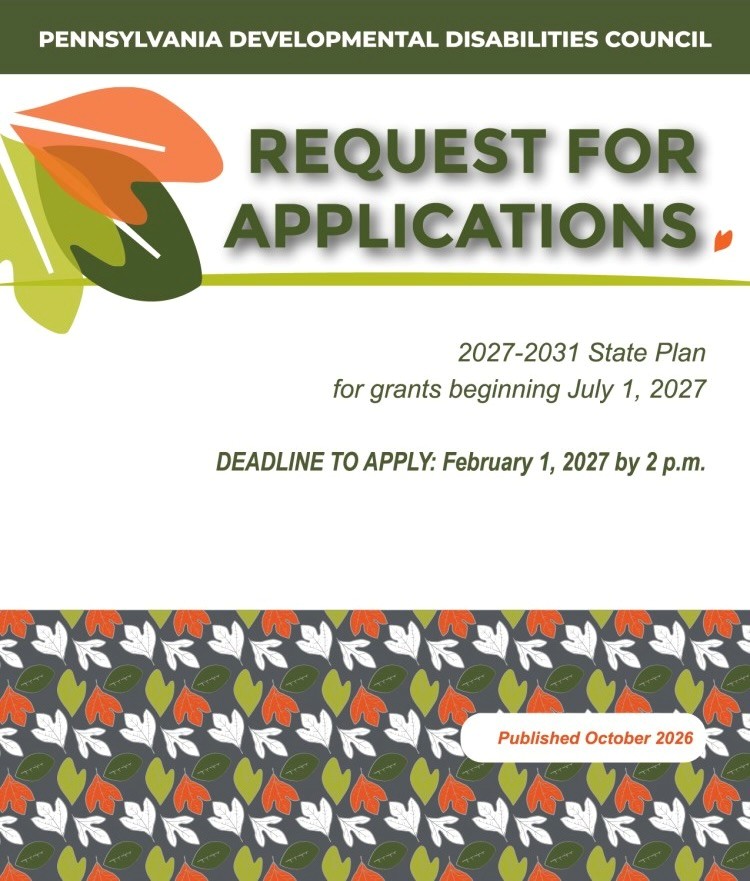
Council releases its 2027 – 2031 State Plan and Request for Applications
Our new 2027–2031 State Plan is now available on our website. Federal law requires the Council to develop a five-year state plan outlining how it will fulfill its responsibilities under the Developmental Disabilities Act (PL 106-402). We have also released a Request for Applications (RFA) booklet with detailed instructions on how to prepare and submit a funding application. The current RFA identifies one project area we plan to fund in the upcoming cycle: the Leadership Empowerment and Advocacy Fund. Additional project areas and funding opportunities connected to our five-year State Plan will be announced in future RFAs.
Council’s Community Grant Application Period is Open
Our Community Grants fund short-term projects that bring together people with and without disabilities to create positive change in their local communities and improve the lives of everyone. We support projects that make community spaces, programs, and activities more inclusive and accessible to people with disabilities. When needed, projects work to change existing community practices or environments so people with disabilities can participate fully and equally alongside other community members. We accept applications on a rolling basis and run for 12 months. Our website includes additional information about the Community Grants Program.

Project Officer McKinley Rouse attended the quarterly State Advisory Council on Early Childhood Education and Care in October. Additionally, he attended the monthly meeting of the National Community of Practice for Substance Use and Individuals with Developmental Disabilities/Autism (IDD/A) professional training workgroup. The group is working on training materials for the IDD/A and substance use communities.

Preschool to Prison Pipeline Project; The Institute on Disabilities at Temple University
The Trauma Informed Practice in Preschool Supports (TIPPS) project helps caregivers and early childhood educators. It gives them tools and ideas to use trauma informed care. These tools can help lower the use of punishments that take kids out of preschool, like suspensions and expulsions. The project now has a website with history, research and its complete group of Trauma-Informed Practices in Preschool Supports (TIPPS) resources available.

Bipartisan House Resolution Reaffirming the Right of Disabled People to Live in Their Communities
A bipartisan House resolution, House Resolution 1586, has been introduced affirming that people with disabilities have the right to live and receive services in their homes and communities rather than in segregated institutions. Led by Reps. Debbie Dingell (D-MI) and Brian Fitzpatrick (R-PA), the resolution recognizes the Olmstead decision as reflecting Congress’s intent to support community integration and has bipartisan support from additional members of Congress.
Pennsylvania State Police Launch Blue Envelope Program to Support Individuals with Disabilities During Law Enforcement Encounters
The Pennsylvania State Police recently launched the statewide Blue Envelope Program, an initiative designed to enhance communication and support for individuals with disabilities that could impact their ability to communicate (such as with autism and/or intellectual disabilities or dementia) during law enforcement encounters.
Cameras in Special Ed. Classrooms: Safety Measure or Privacy Invasion?
As debates about the use of technology in classrooms intensify, some parents and advocates question whether placing cameras in classrooms that house students with significant developmental or intellectual needs is a necessary safety measure or an infringement on privacy.
Pennsylvania Pulls License From Group Homes After Philadelphia Resident’s Death
Pennsylvania regulators have revoked the license held by Resources for Human Development to operate homes for people with intellectual disabilities across Southeastern Pennsylvania, following the February death of a Philadelphia resident after what investigators say was medical neglect. The resident was found dead on the morning of February 23. State investigators concluded the death stemmed from serious neglect and systemic failure within the organization.
Looking Ahead to H.R. 1: Six-Month Medicaid Renewals Coming Next Year
Starting in 2027, many Pennsylvanians with Medicaid will have to renew their coverage twice a year instead of once a year. Under the federal budget law passed in 2025, adults ages 19 through 64 who get Medicaid through the Medicaid expansion group will have their eligibility reviewed every six months instead of every 12 months. The Pennsylvania Department of Human Services (DHS) will begin implementing this change on January 1, 2027. Find out what you need to know in this article.
How States Are Shaping Home- and Community-Based Services
States face growing demand for HCBS driven by aging populations, better life expectancy for people with disabilities, and a long-standing focus on reducing reliance on costly institutional services. As lawmakers continue to enhance supports for older adults and people with disabilities, legislative choices regarding program authority, eligibility, oversight and payment will shape the landscape of home- and community-based services in the years to come.
The State of America’s Direct Support Workforce Crisis 2026
American Network of Community Options and Resources (ANCOR) 2026 report, “The State of America’s Direct Support Workforce Crisis” explores challenges and highlights the resulting impacts upon the direct support workforce and the continued ability of people with I/DD to access the services they require to live and thrive within their homes and communities.

Request for Proposals – Community Care Corps
Community Care Corps encourages organizations across the country to apply for 18-month grants ($30,000–$200,000) to develop and scale innovative volunteer programs that provide nonmedical assistance to family caregivers, older adults, and adults age 18 and older with disabilities. Projects funded through this initiative will increase the number of community-based volunteer programs available to provide nonmedical assistance while decreasing the number of family caregivers, older adults, and adults with disabilities who need assistance in maintaining independence in the community but are unable to obtain help.
Leading the Future while Learning from the Past: Part 1
From the National Leadership Consortium on Developmental Disabilities, this resource asked authors who have deep knowledge and were often involved in the founding and early days of key movements and concepts in the disability field to share their perspectives on where these ideas came from, how they changed over time, and where they go next. At a time of change, the authors affirm and remind readers of core values for supporting people with developmental disabilities to live valued lives in the community of their choice.
Community Living Is a Civil Right: A Guide to Understanding Olmstead v. Lois Curtis, the Integration Mandate, and the 2026 Office of Legal Counsel Opinion
This guide is about one of the most important rights disabled people have: the right to live in the community. “Disabled people have the right to live in their own homes and neighborhoods. They have the right to the services that make that possible. And they have the right not to be pushed into a nursing home, a psychiatric hospital, or another institution when they could be served at home.”
Make It Count: Strengthening Disability Data through Partnership, Participation, and Representation
To prepare for the decennial Census, the National Disability Rights Network (NDRN) convened Protection and Advocacy (P&A) staff, researchers, and federal and state coalition partners to discuss how people with disabilities can be more accurately counted, meaningfully represented, and effectively served through federal data systems. The convening explored barriers to participation in federal surveys, limitations in current disability data collection methods, challenges related to disability question design, and strategies for improving outreach, communications, and advocacy.
National Disability Policy: A Progress Report, 2026
The National Council on Disability (NCD) released its annual progress report, focusing on a review of governmentwide disability policy developments over the last year. The progress report evaluates major developments in disability policy across key areas including healthcare, transportation, education, employment, and technology, while laying out recommendations to address ongoing challenges to the rights of individuals with disabilities. This report points to historic gains in employment and strategic shifts in health research but also cautions policymakers about the detrimental impact of regulatory delays, ongoing transportation barriers, and legal reinterpretations that threaten to erode protections that Congress intended when it enacted the Americans with Disabilities Act (ADA).

Tuesday, November 17, 2026; 2 – 5 pm
National Disability AI & Enabling Technology Virtual Summit
Online
Join people with disabilities, families, professionals, educators, advocates, technology developers, and disability leaders from across the country for a free virtual event exploring the future of artificial intelligence (AI) and enabling technology. Artificial intelligence has the potential to become one of the most powerful enabling technologies ever developed. Learn practical, real-world ways AI can support independence, communication employment, education, safety and everyday life. You’ll hear from national leaders, technology experts, and people with disabilities who are using AI in their daily lives. Through keynote presentations, breakout sessions, live demonstrations, and discussions, you’ll learn how to maximize the benefits of AI while minimizing its risks.
Wednesday, November 18, 2026; 12 – 1:30 pm
Pennsylvania Disability History Collaborative Semi-Annual Meeting
Online
The meeting will feature “Who’s in Control? Community Archives of Self-Determination,” a presentation by Collaborative member Ashten Vassar-Cain exploring the Pennhurst Memorial & Preservation Alliance (PMPA) community archives initiative. A Zoom link will be emailed to the address you registered with, the morning of the event.
December 3 – December 5
TASH Conference: Justice and Liberty for All
Loews Philadelphia Hotel, 1200 Market St., Philadelphia, PA 19107
Each year, the TASH Conference brings together our constituents to share resources and success stories, learn about field-driven best practices, and network within a community engaged in shared values. The Conference is attended by passionate leaders, experts, and advocates from every corner of the disability community. Conference attendees are influential in their fields and communities and play an important role in the provision of services and supports for individuals and organizations around the world; and include professors and researchers from leading institutions; those involved in local, state, and federal governments and public policy; special and general educators, and school administrators; self-advocates, adult service providers; students, family members, and many others. This year’s conference theme is Liberty and Justice for All.
[The PADDC Spotlight is a publication of the Pennsylvania Developmental Disabilities Council (PADDC). Each monthly issue “shines a spotlight” on different Council goal areas, projects, advocacy priorities, and information of top concern to the Council.]
Copyright ©2026 Pennsylvania Developmental Disabilities Council, All rights reserved.